
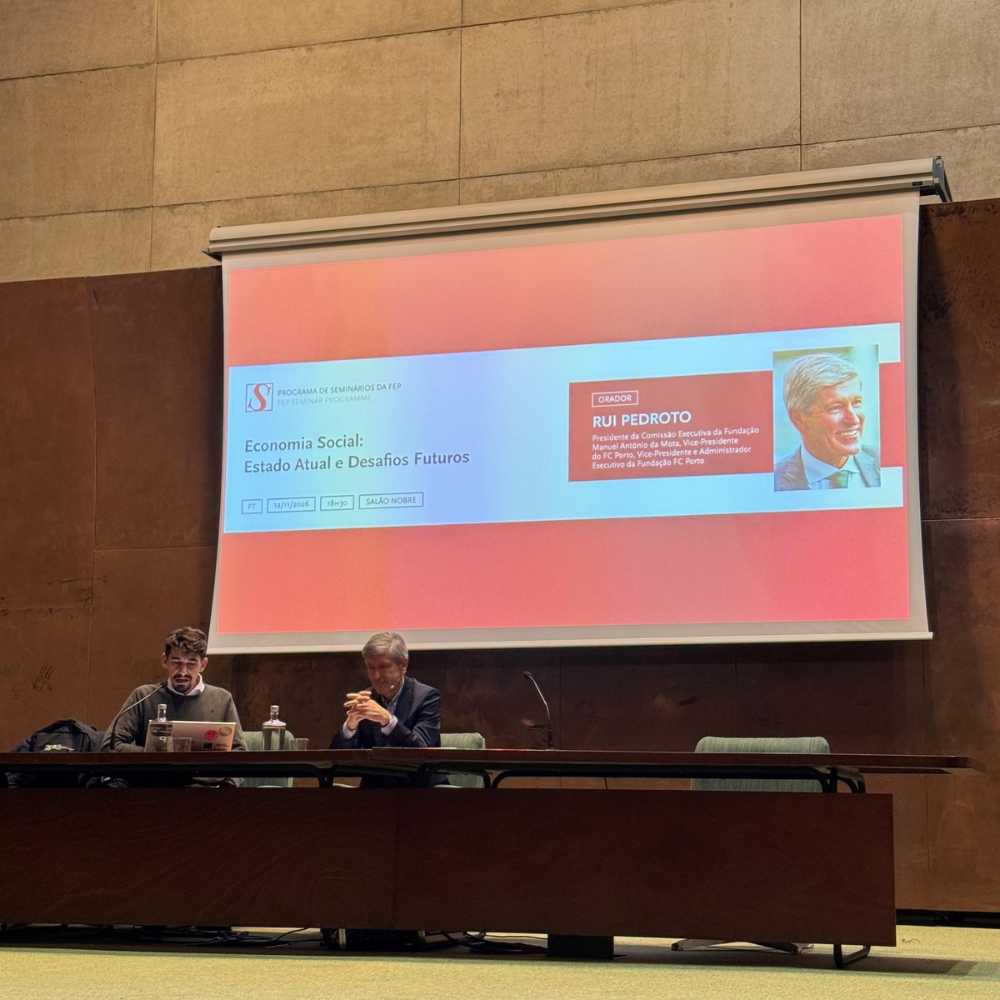
“Today, it is no longer possible for each organisation to work in isolation.”
This was one of the key messages shared by Rui Pedroto during the seminar “Social Economy – Current State and Future Challenges”, held on 12 November at the Faculty of Economics of the University of Porto (FEP).
The Rural Impact Hub (RIHU) attended the session, which featured a presentation by the Chairman of the Executive Committee of the Manuel António da Mota Foundation. The seminar provided an opportunity to reflect on the role of social economy organisations and the challenges they face in delivering more effective, sustainable and community-centred solutions.
Throughout his presentation, Rui Pedroto emphasised the importance of putting people at the heart of organisations, strengthening cooperation between institutions and finding new ways to ensure the sustainability of social impact initiatives.
We would like to highlight five key reflections from the session that we believe are essential for those working within the social economy ecosystem:
1. Cooperate more, work less in isolation. Working in networks makes it possible to share resources, knowledge and skills, avoiding duplication of efforts and developing more effective responses to community challenges.
2. Understand the territory before seeking solutions. Organisations must understand people’s real needs and local dynamics, aligning their mission with what they have the capacity to achieve.
3. Invest in people and capacity building. The quality of social services depends on skilled teams, well-prepared leaders and management practices capable of responding to the sector’s challenges and transformations.
4. Ensure financial sustainability. Diversifying revenue streams, improving management efficiency and exploring alternative financing mechanisms are essential steps towards ensuring the long-term continuity of organisations.
5. Make social innovation a response to community challenges. Rather than simply creating new projects, the priority should be to develop solutions that address specific needs, encourage people’s participation and reinvest resources in the social mission.
For RIHU, these reflections reinforce the importance of continuing to build bridges between entrepreneurs, mentors, partners and communities, promoting a locally grounded approach that values local knowledge, collaboration and the creation of opportunities in rural areas.
Participating in this seminar was also an opportunity to reflect on our own work and on how we can continue contributing to a more collaborative, sustainable and people-centred social innovation ecosystem.
Because creating social impact is not about doing everything alone, but about bringing people, resources and knowledge together to build solutions that make a difference.